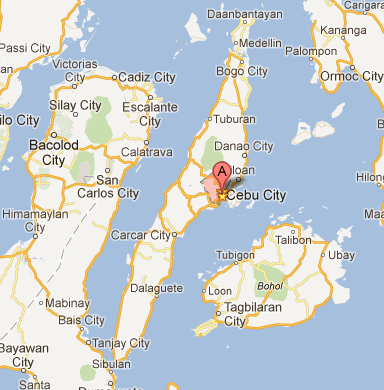
Cebu City, officially the City of Cebu (Cebuano: Dakbayan sa Sugbu; Tagalog: Lungsod ng Cebu), is a 1st class highly urbanized city of the island of Cebu in the Central Visayas Region, Philippines. According to the 2015 census, it has a population of 922,611 people, making it the fifth-most populated city in the nation and the most populous in the Visayas.[
It is the seat of government for the province of Cebu, but is governed separately from it. The city is a significant center of commerce, trade and education in the Visayas. It is the Philippines’ main domestic shipping port, and is home to about 80% of the country’s domestic shipping companies.
Cebu is the country’s oldest city; it was the first Spanish settlement,[ and the first capital of the Philippines. It is considered the birthplace of Christianity in the Far East. It is the “Second City” of the Philippines after Manila.
Cebu is bounded on the north by the town of Balamban and the city of Danao, on the west by the city of Toledo, on the east by the cities of Lapu-Lapu and Mandaue and the towns of Liloan, Consolacion and Compostela, and on the south by the city of Talisay.
The energy, the people, the architecture, the food…if Cebu isn’t already in your travel plans, then you might want to make some adjustments.
As the center of trade, commerce, and tourism in the Philippines, you can only imagine that there is a lot to be seen and done in Cebu. From historic sites where Spanish settlers first landed to incredible underwater marine parks teeming with tropical sea life, you won’t be able to get enough of this South East Asian hub.
Let’s explore the best things to do in Ceby City:
1. Cebu Heritage Monument
Cebu Heritage Monument
With centuries full of invasions, battles, and revolutions, Cebu is a city with stories to tell. Visit Cebu Heritage Monument for a synopsis.
Built with dark stone and bricks, the structure is a tangled sculpture of ships, churches, crosses, and key historical figures that are as mysterious as they are thought provoking. With centuries of history and tales, consider hiring a guide before you go or taking ones offer when you arrive. You’ll enjoy the local interaction, be able to ask burning questions, and get some background information you would have otherwise missed out on.
This is a great way to start your vacation in Cebu in that it will give you insightful context to apply for the rest of your visit.
2. Colon Street
Colon Street
A trip to Cebu isn’t complete without a walk down Colon Street. While at a glance, this crumbling stretch of sidewalk may look dull but come a little closer and you’ll discover that there is much to see, do and taste.
Lined with markets selling colorful backpacks, jewelry, clothing, and shoes, this street makes for a great place to buy your souvenirs. Don’t be afraid to engage in some friendly haggling with smiley vendors. You can try yummy street food, mingle with the locals, and take some awesome photos on Colon Street.
3. 1730 Jesuit House
1730 Jesuit House
You wouldn’t expect such a memorable experience to begin in a hardware store, but it will. Stepping inside the 1730 Jesuit House feels like stepping 100 years back through history.1730 Jesuit House is a local project that aims to preserve one of Cebu’s historic sites. This ancient house has survived typhoons, earthquakes, and foreign invasions, yet still stands to tell the tale.
Your tour guide will take you through an hour-long journey while showing you restoration efforts, along with artifacts and antiques including cameras, carvings, furniture and even 100-year-old cedar chest that still gives off a beautiful aroma.
4. Dive with Whale Sharks
Whale Sharks
The biggest fish in the world are right off the coast of the Philippines. Although they are called “sharks”, these gentle beasts are far from what you may imagine.
Oslob Whale Sharks Tour Company is one of the most respected in the business. They guarantee, with 99% certainty, that you will witness and have the opportunity to swim alongside a mighty Whale Shark.
These particular Whale Sharks are considered wild, but instead of migrating to warmer waters for parts of the year, they stick around as the fishermen continue to feed them. That means this experience is available no matter what time of the year you visit.
5. SM Mall Cebu
SM Mall Cebu
If you want to experience life as a local, step into one of the most popular shopping malls in Cebu. SM Mall is a great place to take your kids to get out of the heat for a couple of hours with lots of activities. There is an ice-skating rink, children’s playground, and arcade where you can rack up tickets to win all sorts of prizes. Not to mention, SM Mall is located directly on the coast that offers gorgeous, unobstructed views of the water- perfect for a family photo.
I must warn you though: this mall is huge! There 4 quadrants with plenty of food, shopping, and benches that will quickly kill time.
6. Cebu Metropolitan Cathedral
Cebu Metropolitan Cathedral
Unlike many other cathedrals and churches in Cebu that give you a window into Filipino culture, the Cebu Metropolitan Cathedral focuses much more on the history of religion in the city. More specifically, this cathedral stands as a history lesson of how Christianity came to plant such deep roots in a country whose previous religion had deeper ties with Hinduism and Buddhism.
Cebu Metropolitan Cathedral is a nice change of pace from other tourist attractions, as not as many tourists know about this site. You can leisurely stroll through the cathedral taking in the impressive architecture. You may even join in on Sunday mass where you’re sure to be greeted with kind ‘hello’s and smiles from Filipino locals, mildly surprised to see you.
7. Mountain View Nature Park
Mountain View Nature Park
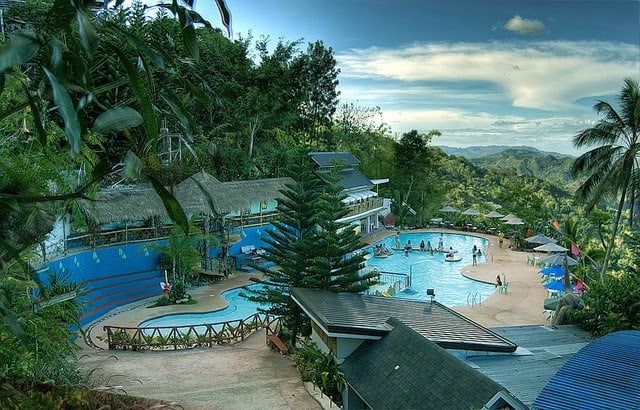
Here is another great place to come with your family as Mountain View Nature Park has something for everyone. For the kids, there is a water playground! Let the kids run wild in the shallow pool with slides and stairs. There is also a play place on land that really puts the ‘jungle’ in jungle gym as it is surrounded by lush greenery.
For the parents, you’ll be awestruck by the tropical views of rolling hills covered with undisturbed jungle life. You can see for miles and miles from the viewpoints all around the park.
There is a restaurant, café, public washrooms, and even hotel rooms. This is a wonderful place to spend the day.
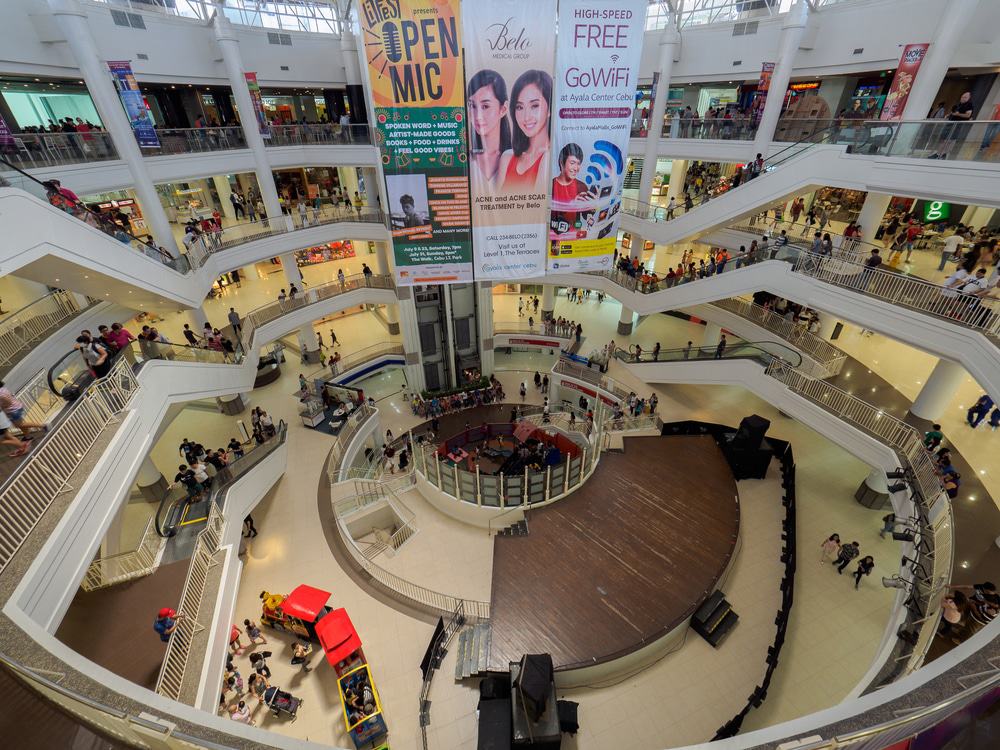
8. Ayala Center Shopping Mall
Ayala Center Shopping Mall
Going to the shopping centers in the Philippines is a cultural experience in itself, starting with the food.
Every great shopping mall around these islands has a food court that you must try. From classic Filipino dishes to their ever-popular fast food chains, every bite will be better than the next.
After you’ve got your fill, have a walk around to look at the clothing and shoe shops. They’ve got big brands like H&M and local brands for you to browse. And if you’re lucky, there will be a live band playing somewhere within the vicinity.
Don’t be in such a rush to get out of there just yet! Ayala Center Shopping Mall is surrounded by beautiful green landscapes that make for a nice place to relax. Bring a drink from the food court and just people watch for a while. You’d be surprised what you can learn about a country by just sitting still.
9. Basilica del Santo Nino
Basilica Del Santo Nino
The oldest Catholic Church in the Philippines is located right here in Cebu!
“Mercy and Passion” are the tenets of Basilica del Santo Nino, founded in 1565, which still bring many locals here to worship on a daily basis. This Catholic Church holds a regular mass where families and children come to show their faith.
Have a walk though the church halls to see ancient paintings, gorgeous archways, stained glass windows, and overall, a piece of architecture that is awe-inspiring. You can view 17th century relics in the museum or visit the library filled with books covering modern subjects of all kinds.
10. Jollibee
Jollibee
The most beloved fast-food chain in the entire country is Jollibee. Internationally recognized by world-renowned chefs like Anthony Bourdain, this place is not to be overlooked.
At a glance, you might think that some of their menu items are strange and that the combinations are unconventional- but just go with it. Fried chicken comes with a fried egg, rice and coffee; hotdogs are topped with cheese and they offer a spam sandwich with mayo.
Perhaps the most popular Jollibee treat, however, is the Halo Halo- a desert smorgasbord of red beans, cubes of jello, white coconut, shaved ice and flan. Ask almost any Filipino- they love this stuff.
11. Crown Regency Sky Experience
Crown Regency Sky Experience
The Crown Regency isn’t just a hotel; it’s also a thrill seeker’s paradise with extreme sports that defy gravity and conquer fears.
Ride the Edge Coaster which circles the perimeter of the 38th floor, strap yourself up and walk along the translucent glass floor of the building which is 126.55 meters high, or take an extreme zip line 473 feet in the air. There are even more seemingly death-defying activities if you dare.
12. Jumalon Butterfly Sanctuary
Jumalon Butterfly Sanctuary
Nature lovers come hither! There is a butterfly sanctuary in Cebu where you can walk through a mini rainforest teeming with tropical plants and flowers with beautiful butterflies fluttering all around. Keep your camera out just in case one decides to land on your nose for a selfie.
The Jumalon Butterfly Sanctuary has an impressive collection of butterfly specimen encased in glass that shows just how diverse the buttery fly family truly is.
Bring some cash as there is a small entrance fee, but it goes towards a wonderful cause.
13. Taboan Public Market
Taboan Public Market
Whether you’re in the mood to taste or just to look, you can find a wide array of dried fruits, seafood, meat, and nuts at Taboan Public Market. We’re talking about piles of colorful mango, shrimp, pineapple and fish- a rainbow of goodies!
Everyday, locals come from all around the city to collect these ingredients for family recipes and casual snacks. As this is a local market, not many items will be tagged with a price. Keep your wits about you when bartering and haggling to be sure you get a fair deal.
14. Tops Lookout
Tops Lookout
There is a good reason why Tops Lookout has remained such a popular tourist destination in Cebu. That’s because you will get the most spectacular 360-degree view from here and only here.
Tops Lookout represents what makes the Philippines so special in that you get a taste of lush greenery, intricate city, and winding waterways all in one visit.
The view at night is especially beautiful as you can see the veins of the city all lit up and sparkling against the darkness.
Try to come in the morning or at night so that you can avoid the heat, and also so the large crowds of tourists with their selfie sticks!
15. Spa Esc
Spa Esc
A vacation isn’t complete without a trip to the spa. Spa Esc, located in the Radison Blu Hotel, offers a wide selection of relaxing services from head to toe.
You’ll find many traditional styles of Asian massage such as Awakening Filipino Hilot Massage, as well as familiar styles of massage such as aromatherapy.
The massage therapists are well trained and very professional. The atmosphere is calming with sounds of chimes and brooks in the background. This is the perfect place to unwind.
16. Taoist Temple
Taoist Temple Cebu
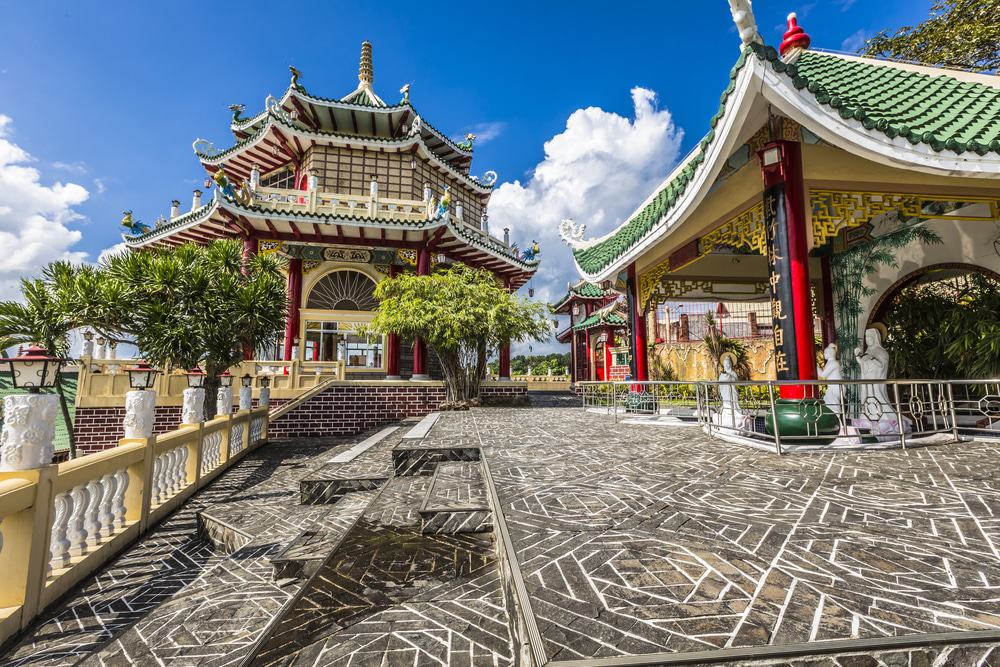
In the Beverly Hills subdivision of Cebu, you’ll find a beautifully designed Taoist Temple. Located 300 meters above sea level, expect lots of steep steps and winding paths that will get your blood pumping as you make you way to the top. Once you reach the temple, you’ll be greeted with beautiful views of the island.
Join in on a Taoist ritual of taking two blocks of wood into the temple and dropping them on the floor in front of the shrine. If both blocks fall face up, then the gods are permitting you to make a wish; if not, then the gods don’t believe it’s time for your wish to come true. Before you enter the temple, however, be sure to wash your hands and take off your shoes.
17. Fort San Pedro
Fort San Pedro
As you travel the Philippines, you’ll notice a curious Spanish influence in the country’s currency, food, architecture, and even their language. Visit the Fort of San Pedro and this mysterious element will become much more clear.
On April 7, 1521, the Spaniards arrived on the coast of the Philippines, which marked the beginning of Spanish colonization.
However, Fort San Pedro was not built to mitigate the conflicts between native Filipinos and the Conquistadors, but rather was built in 1738 under the command of Miguel López de Legazpi to protect against Muslim raiders.
However, during the Philippines Revolution, it was eventually over taken by Filipino revolutionaries.
When you visit this crumbling fortress you’ll certainly be thinking, “Oh, if only walls could talk.”
18. Terrazas De Flores Botanical Garden
Terrazas De Flores Botanical Garden
Get away from the hustle and bustle of the city streets and instead, surround yourself with nature in it’s purest form.
The Terrazas De Flores Botanical Garden offers terraced flower gardens planted in the sides of rolling mountains with a breeze that balances the heat.
Walk hand-in-hand with your loved one under floral gazebos or have a seat at the picturesque café to take in the sights.
While this botanical garden is a bit outside of the city center, the drive to reach it is just as enjoyable. Hire a local motor taxi for a truly thrilling day.
19. Eat Lechon at Rico’s Lechon
Rico’s Lechon
If you know anything about the Philippines, you’d know that lechon is a national dish that serves as the culinary pride and joy of this country.
In Spanish, “lechon” means, “suckling pig”- no surprise there. With the Spanish colonization, came this culinary gem, which is often roasted and eaten at large family gatherings and celebrations.
Lucky for you, however, you can get lechon any day of the week in Cebu when you visit Rico’s Lechon. This will be the most succulent, juicy, flavorful pork that you’ve ever had in your life. Served with rice and Pinakurat vinegar, this is sure to be a dish you’ll never forget.
20. Nuat Thai Foot and Body Massage
Nuat Thai Foot And Body Massage
If you’re looking for a deep tissue massage before you climb onto a long flight destined for home, stop by this Thai massage center.
Using traditional Thai massage techniques, the therapists bend your body like a pretzel and walk on your back like surfboard. It might be a bit intense in the moment but will leave you feeling like a new person!
They also offer foot massages, back massages, Swedish massages and aromatherapy massages for great prices.
21. Island Hopping
Sumilon Island
Cebu is surrounded by plenty of beautiful tiny islands with stunning white sand beaches and crystal blue water.
You’ll find many tour offices that offer island hopping packages, which span from half-day to full-day tours. Many of these packages include a delicious lunch where fresh mango is almost certainly involved.
These day trips will whisk you out on to the water in a catamaran and take you to destinations where you can snorkel over the reefs, fish with the locals and visit some small villages.
22. Scuba Diving
Scuba Diving, Cebu
Some of the best diving in the world can be experienced in the Philippines. You’ll need to have your Open Water Diving Certificate previous to showing up or you can come to Cebu to take a scuba diving course.
Diving trips in Cebu include visits to the Hilutungan Marine Sanctuary and Nalusuan Santuray filled with tropical sea life. You’ll have the chance to spot Thresher sharks, Mandarin fish, blue sea stars, and bizarre sea sponges.
Better yet, the Philippines offers some of the least expensive diving excursions in the world.
23. Yap San Diego Ancestral House
Yap SanDiego Ancestral House
Built in 1675, Yap San Diego Ancestral House is one of the oldest and best-preserved houses in all of Cebu.
It’s fascinating to get up close and personal with such an ancient structure that has managed to maintain its original integrity. You’ll see that the lower part of the house is made out of coral stones- this includes the walls, stairs, ceilings and floors. The roof is made with Chinese bricks, also called ‘terracotta’ tiles.
All around the house you will find old paintings, furniture, and antiques acquired by merchants from the 16th century through the 19th century making this house a museum of sorts.
There will be an English-speaking tour guide to lead you through the house, throwing down interesting stories and facts to go with every room.
24. Join Cebu’s Fun Run
Cebu’s Fun Run
Each and every week, Cebu hosts a fun run event. That means that if you’ve brought your running shoes, you have the chance to connect locals on a level that only endorphins can create.
From marathons to family runs and seaside jaunts to color runs- there is a whole schedule already created and waiting for you to peruse. Check out their Facebook to get more information.
25. Cebu Westown Lagoon
Cebu Westown Lagoon
You can get a day pass to Cebu Westown Lagoon, which offers everything a holiday maker needs to kick back and enjoy some rays.
This man-made lagoon features refreshing pools of water, gazebos, water fountains, Jacuzzis, and giant pool slides to help you develop a fantastic tan.
When the sun goes down, make you way to the MO2 Bar where you can enjoy some live music from local bands that really know how to rock. This bar also features KTV so you can get your karaoke on.
Cebu is known for its world-class beaches, exquisite resorts and the Sinulog Festival. The Sinulog Festival is considered as the biggest and grandest fiesta in the Pearl of the Orient. It is held on the third Sunday of January. It is basically a dance ritual to honor of the image of Señor Santo Niño. The ritual dance moves to the beat of the drums and resembles the current or sulog of the former Pahina River of Cebu.
The dance ritual actually has pagan origins and the natives danced the Sinulog to honor anitos and wooden idols even before the coming of the Spaniards. The image of Señor Santo Niño was originally the gift of Magellan to Rajah Humabon and Queen Juana after they were baptized together with their followers. Following the death of Magellan at the hands of Lapu-Lapu, the surviving members of the expedition were able to make it back to Spain.
Sinulog – image source: courtesy of Peter ParconWhen the Spaniards returned to Cebu under the command of Miguel Lopez de Legaspi, they bombarded the village. The image of Señor Santo Niño was later discovered inside one of the burning huts stored inside a wooden box by Juan Camus. The natives continued to perform the dance ritual in front of wooden idols or the image of Señor Santo Niño. Before the Sinulog became the grand festival it is today, only candle vendors performed the Sinulog while making offerings. The fiesta was also low key at this time.
By 1980, the first Sinulog parade was organized by then Regional Director of the Ministry of Sports and Youth Development (MYSD), David S. Odilao Jr. A demonstration of the dance was performed by Nang Titang Diola of Mabolo. The first Sinulog Street Dance Parade was lead by physical education teachers from seven schools and universities. The City of Cebu later thought of using the parade into a festival to rival the festivals in other parts of the country.
The Sinulog organization was formed with the task of conceptualizing the festival and making it a major event. It created the logo that did not include an image of Señor Santo Niño since it was considered sacrilegious. Instead, the coat of arms of Señor Santo Niño was used for the logo.
Sinulog – image source: courtesy of Peter ParconWhen Sinulog 1981 was organized, the history of Sinulog was depicted in the parade. Seven different periods in history were depicted in seven floats while dancers wore costumes associated with each period. As each year passed, the festival became bigger and better until it became the grandest festival in the Philippines. Initially, the contingents came from Cebu, but after a while contingents from other cities and provinces started to participate in the Sinulog.
Visitors
An increase in the number of spectators of the Sinulog Grand Parade was noted with the creation of the Balik-Cebu program in 1986. The program also resulted to direct flights from Cebu to San Francisco. The festival now attracts millions of pilgrims along with thousands of balikbayans each year. With the increasing number of people watching the grand parade, crowd control has become a perennial issue. While different strategies were used in dealing with this issue, the solution remains elusive and the organizers are still working on solving this perennial problem each year.
Sinulog – image source: courtesy of Peter ParconEven with some issues organizers of the Sinulog Festival had to deal with, the festival continues to become bigger and grander each year. From a simple revival of an old ritual dance, the Sinulog is now one of the most awaited events in the country.
Cebuanos aren’t the only ones who should be proud of Cebu.
One of the most highly-developed provinces in the country, Cebu has earned recognition here and abroad. In fact, Condé Nast Traveler Magazine named it the 7th best destination in the Indian Ocean-Asia region in 2007.
Its capital, Cebu City, is not lagging behind either.
Hailed as the “Queen City of the South,” Cebu City is the trade and industry hub in the Visayas. It boasts of many attractions that will impress foreign and local tourists alike.
But aside from their durable guitars and luscious dried mangoes, what else should we know about this province?
Here are 10 interesting things about Cebu you probably didn’t know that will blow your mind:
1. Ancient Cebuanos used “genital jewelry.”
Tantrism
Tantrism is a collective term used to describe various esoteric rituals and traditions which originated in India thousands of years ago. It believes in the principle that sexuality is a doorway to the divine, and that the “highest transcendental ecstasy” can be achieved through sexual union.
Earliest record of Tantrism in Southeast Asia came from I-Tsing, a Chinese Buddhist pilgrim who recorded Tantric practices in the Srivijaya Empire in 671 A.D.
Philippines is believed to have been part of the Majapahit Empire’s trading outposts. The said empire was ruled at that time by King Kertanagara who introduced a religion based on Tantric Shiva-Buddha mixture. For this reason, pre-Hispanic Filipinos, particularly Cebuanos, are believed to have been influenced by Tantric practices that are common during that era.
In his diary written in the 1500’s, Italian chronicler Antonio Pigafetta describes Cebuanos as having their “penis pierced from one side to the other near the head, with gold or tin bolt as large as a goose quill. In both ends of the same bolt, some have what resembles a spur, with points upon the ends; others are like the head of a cart nail…In the middle of the bolt is a hole, through which they urinate.”
Pigafetta was also told that the women requested the use of these accessories, and without these genital paraphernalia, no sexual intercourse would occur.
2. The Golden “Death Masks.”
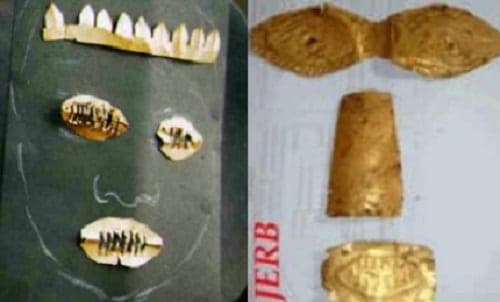
Gold death masks of Cebu. Photo credit: Cebu Daily News and Southwestern University Museum.
Discovered in 2008 during an excavation activity in Plaza Independencia, the gold death mask (see photo above) is only one evidence that ancient Cebuanos already had intricate culture and burial practices before the Spaniards arrived.
The said death mask was first described by the Jesuit Pedro Chirino in his Relaciones de las Islas Filipinas, published in Rome in 1600. During the ancient times, Cebuanos who could afford it honor their departed loved ones with masks made by pounding gold into thin sheets. They would make separate pieces to cover the eyes, nose, and the mouth.
Gold was believed to contain magical powers, and the use of death mask was meant to protect the soul from evil forces. The death mask was only one of the things that pre-Hispanic Filipinos gave to the deceased as gifts. Just like the ancient Egyptians, they also buried their loved ones with items such as iron tools, ceramics, and other valuables to help them survive their journey in the afterlife.
The first gold death mask discovered in the Philippines was the Oton Gold Mask of Iloilo. Found in 1973 in the pre-Hispanic port settlement of Katagman, the Oton Gold Mask was declared a National Cultural Treasure (NCT).
3. Museo Sugbo was a former prison.
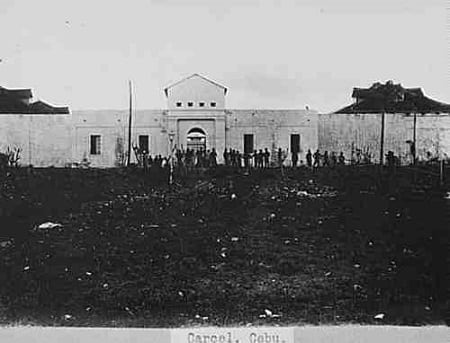
Cárcel de Cebú circa 1901. Photo courtesy of Museo Sugbo.
Museo Sugbo, Cebu’s official museum, was a former provincial jail known then as Cárcel de Cebú. Built during 1870s, the prison was intended to house criminals from the whole Visayas district, which explains its large size when it was constructed.
Cárcel de Cebúhave witnessed several pivotal events during its 135-year history. It once served as a prison for Katipuneros who were sentenced to death, a stable for horses during the American period, and again as a prison where guerillas were tortured by the Kempei-Tei (or Kempeitai) during the Japanese Occupation.
In the 1980s, the prison changed its name to Cebu Provincial Detention and Rehabilitation Center. It was converted into a museum in 2008 as part of the celebration of the 439th Cebu Provincial Charter Day.
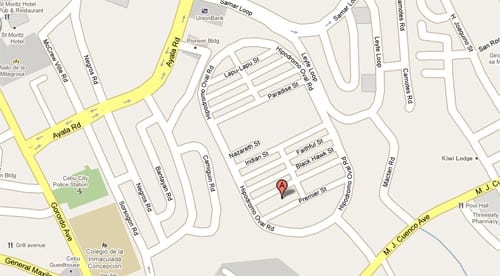
4. Brgy. Hipodromo was a former racetrack for horses.
Known then as Hippodrome, this place was heaven for horse aficionados. Before the war, watching a horse race was part of the Cebuano lifestyle, and Hippodrome was the racetrack that started it all.
The starting point of the race was located near the entrance along M. J. Cuenco Avenue while the Pacific Foundry once housed the clubhouse where people watched and bet on horses.
Hippodrome closed down during WWII, and reopened after the war only to find out that horse racing was no longer profitable. In the end, the business closed permanently.
When a huge fire hit Carreta and T. Padilla in the late 1950s, the mayor opened Hippodrome to serve as a relocation site. The place later became an official barangay and renamed Hipodromo.
5. Leon Kilat’s supernatural powers.
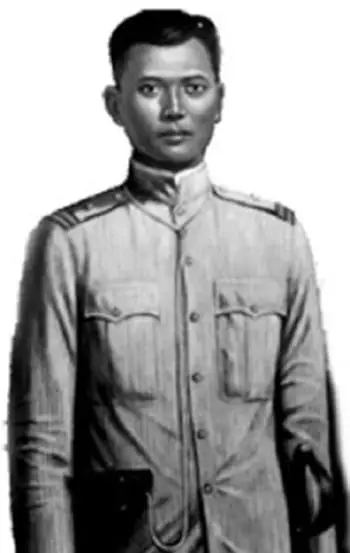
Leon Kilat as depicted by Cebuano artist Manuel Pañares.
Pantaleon Villegas, also known as Leon Kilat, was not born in Cebu (he’s originally from Bacong, Negros Oriental), but his heroism is not something that Cebuanos should forget.
Leon Kilat, then only 24 years old, led the Cebuano Katipuneros in attacking the Spaniards during the famous battle of “Tres de Abril” on April 3, 1898. They were able to drove the Spaniards away and control the province of Cebu for a few days.
But what makes Leon Kilat special?
The answer lies within his life story which almost borders on the supernatural and myth. After working in Cebu for a few years, Leon moved to Manila where he allegedly earned his “kalake” or supernatural powers. He wore talismans and was also known to be a “kublan” or someone who could repel bullets.
Some stories also suggest that Leon Kilat kept a mythical animal called sigbin. This creature allegedly gave him the power to quickly move from one place to another, say one day he’s fighting in Cebu, the next day he’d find himself back to where he was born in Negros Oriental.
However, no legendary tale could match the tragedy of Leon’s death. A few days after the battle, Leon was assassinated by Cebuanos led by his own aide, Apolinario Alcuitas. It is told that they let Leon drink a sleeping potion first before they removed his talismans and killed him as planned.
6. Vic Sotto’s grandfather founded the first Cebuano newspaper.
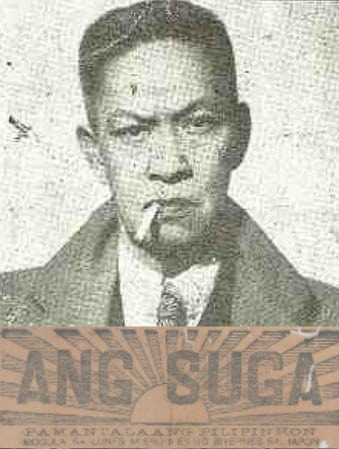
Also known as the “Father of Cebuano Journalism, Language and Literature,” the late Senator Vicente Yap Sotto founded the first ever newspaper written in Cebuano in 1901. The newspaper, which he would named “Ang Suga”, served as an avenue for Cebuano writers to publish their works. Sotto’s daughter, Dr. Suga Sotto Yuvienco, was named after this news magazine.
Aside from Ang Suga, Sotto also wrote “Ang Paghigugma sa Yutang Nataohan,” “Maming,” and “Elena,” which was made into a play. Sotto was the author of Republic Act 53 or Press Freedom Law (known today as “Sotto Law”) which was passed in 1946 to protect journalists from being forced to disclose their news sources.
Vicente Yap Sotto is the grandfather of famous actor Vic Sotto and Senator Vicente “Tito” Sotto III.
7. The “curse” of the Lapu-Lapu Monument.
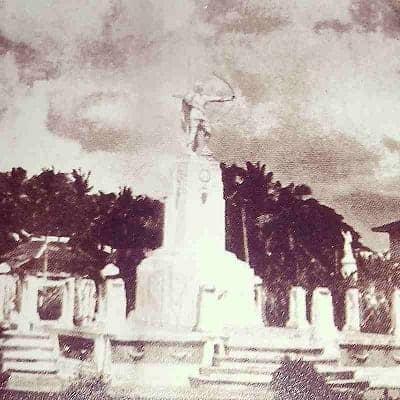
The original Lapu-Lapu statue built in 1933.
The monument in Lapu-Lapu City (formerly called Opon) looks harmless today, but it actually has an intriguing past which soon started a local urban legend.
In 1933, a resolution was passed for the construction of a Lapu-Lapu monument. The original statue (see photo above) shows the legendary chieftain holding a bow with an arrow pointing at the municipal hall.
After the construction was completed, Rito de la Serna, then chief executive of Opon, died. Soon, his two successors followed suit and died even before they completed their term. This tragic incident made several residents superstitious and it didn’t take long before they started to blame the statue for the three deaths.
In 1938, Mariano S. Dimataga, then newly-elected executive of Opon, ordered the renovation of the statue. The bow and arrow were finally replaced by a pestle. Dimataga, on the other hand, remained Opon’s chief executive for the next 32 years until his retirement in 1968.
8. Cebu animals that no longer exist.
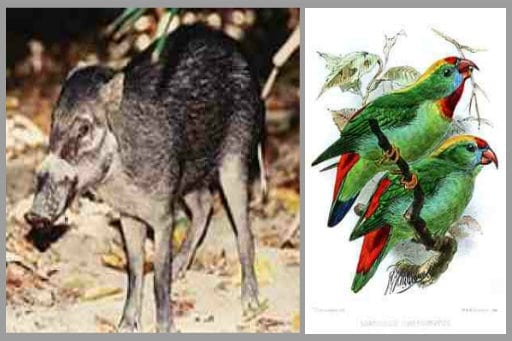
Cebu warty pig (left) and Cebu hanging parrots (right). Both animals are now extinct.
Although Cebu is a province rich in flora and fauna, there were still some unfortunate creatures that Cebuanos failed to save from extinction. Examples of animals that have been wiped out are the Cebu warty pig and the Cebu hanging parrot.
Cebu warty pig (Sus cebifrons cebifrons) is a subspecies of Visayan warty pig. Its status was declared in 2000, and the extinction was mainly caused by habitat destruction, animal hunting, reduced crop raiding , and hybridization.
Cebu hanging parrot (Loriculus philippensis chrysonotus), on the other hand, has been extinct since 1943 but the date of extinction was already set as early as 1906. These beautiful parrots, characterized by overall green with red foreheads, disappeared due to complete deforestation in the 19th century.
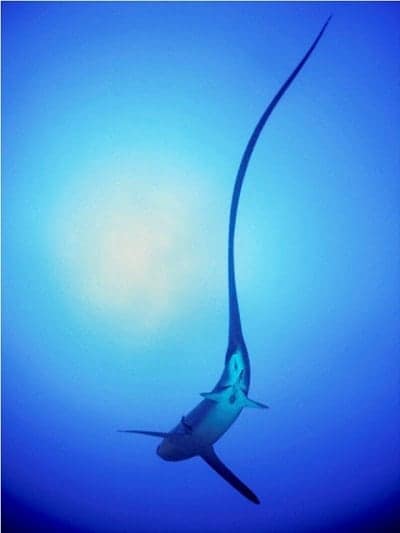
9. Malapascua Island in Cebu is the only place in the world where you can dive with the elusive thresher sharks.
Malapascua (literally means “Bad Christmas” or “Bad Easter”) is an island just off the northern tip of Cebu. It is a popular diving site because of its reputation as the only place in the world where you can regularly see thresher sharks before sunrise.
Thresher shark (Alopias pelagicus), is a type of mackerel shark that was named after its scythe-like tail. It can grow up to a length of 6 meters and are night creatures, which explains why divers don’t often see them around the world.
In 1997, Dik De Boer visited a sunken island near Malapascua and discovered the elusive thresher shark. Turns out, the Monad Shoal serves as the sharks’ cleaning station where they clean their gills and remove parasites from their skin.
Malapascua Island also offers stunning sights like wrecks. There are two wreck sites in the area: One is a WWII boat just 10 minutes from the main island, while the other is a passenger ferry just two hours away.
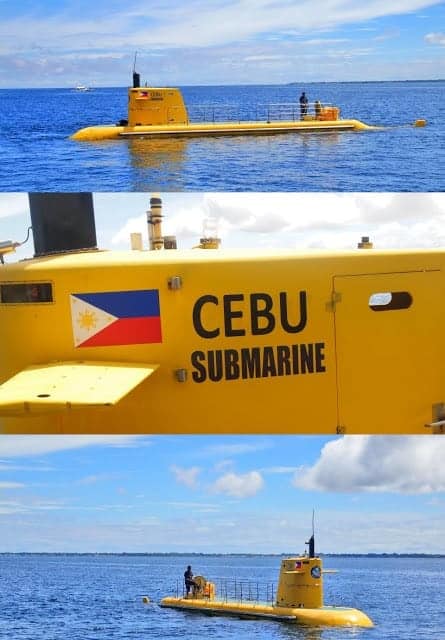
10. Philippines’ first tourist submarine is in Cebu.
Photo credit: travelerscouch.blogspot.com
Built in 1989 in Antwerp, Belgium, the Cebu Yellow Submarine started its operations in 2012 after they received the certificate of accreditation from the Maritime Industry Authority (Marina). It can be found at Imperial Palace Waterpark Resort and Spa in Lapu-Lapu City.The tourist submarine is 22.2 meters long and weighs 99 tons. Using an electro-hydraulic system battery, the submarine can travel up to a speed of five knots. It can accommodate up to 48 passengers at a time. Although it can go as deep as 100 meters, they currently put the limit to only 35 meters below the surface to ensure passengers’ safety.
Unfortunately, the Cebu Yellow Submarine has been suspended twice: The first time was in April last year when it accidentally hit corals at Kontiki Wall, followed by a recent incident when it slammed a motorized boat off the coast of Brgy. Maribago in Lapu-Lapu City.
Cebu is a province in the Philippines consisting of the Cebu Island and many other surrounding islands. It derived its name from the word “SEBU” meaning animal fat. It is known to be a fishing village before the Spaniards came but became industrialized through the years. It is now one of the most developed provinces in the Philippines, with Cebu City as the center of commerce and industry.
Cebu City, the capital of Cebu, is considered to be the oldest city in the Philippines. It is also known as the oldest settlement established by the Spaniards in the country.
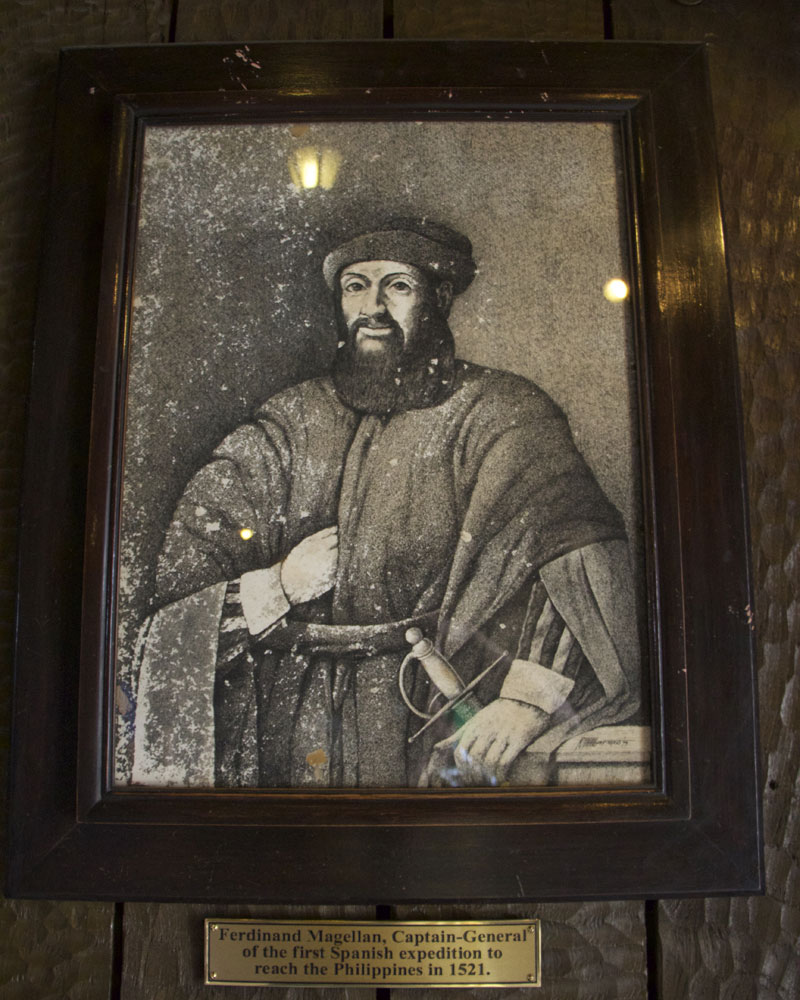
Found in the island are rich traces of the Philippine history left by mostly the Spaniards. Among these historical sites are the Magellan’s Cross found in downtown Cebu (a Christian cross planted by the Portuguese and Spanish explorers as ordered by Ferdinand Magellan upon arriving in Cebu on April 1521), the Lapu-Lapu Shrine (a 20-meter statue found in Mactan erected in honor of Datu Lapu-Lapu, a native leader who instituted the death of Magellan), the Colon Street (the oldest and the shortest national road in the Philippines), the Fort San Pedro (the oldest military defence structure built by the Spanish and indigenous Cebuano labourers under the command of Miguel Lopez de Legazpi), etc.
Through the years, Cebu became more and more industrialized. The rise of big companies, the trend of technology, and the innovation by the people make Cebu very progressive. Cebu is now the home for many BPOs and small to very large companies that contribute to the progression of the whole island especially Cebu City.
Today, when one speaks of Cebu, it means relaxation, luxury, pleasure, and fun, all in one island. For in Cebu, everything is at stake: beautiful resorts, luxury and budget hotels, breathtaking mountains, amazing fun activities, myriad choice of luscious restaurants, and a lot more.







 Rofil's Infographic Blog